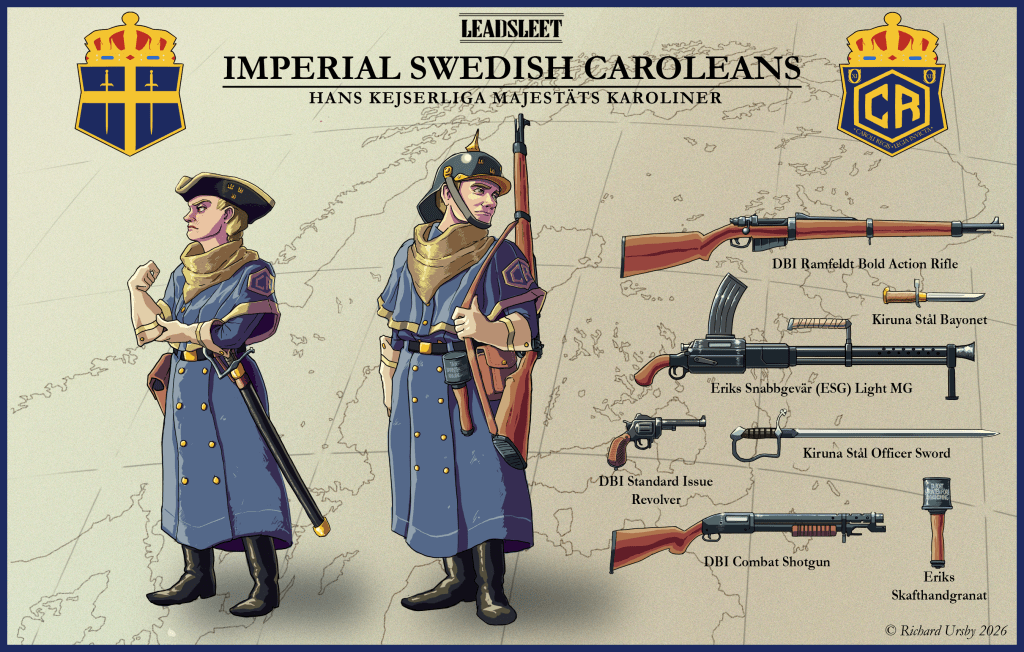
Both the Caroleans and the Empire itself trace their origins to the Swedish military expansion at the turn of the 18th century. Named after Kings Charles XI and Charles XII (Carolus Rex) these elite vanguards of the Imperial infantry carry a piece of the old world with them. Despite the modernization of both the Swedish allotment system and military technology, Caroleans still rely heavily on the old gå-på tactic of closing the distance.
Each squadron consists of seven Caroleans, with one soldier being issued a combat shotgun, another a LMG, and the rest rifles. The latter’s task is to get the former, along with as many riflemen as possible to enemy positions with suppressive fire. In theory, combat then proceeds with the enemy being neutralized with a combination of well-placed hand grenades and trench sweeping with a shotgun. But in reality, these situations often turn to nigh-medieval close combat with bayonets (affixed or not), rifle butts, or even sharpened field shovels and makeshift cudgels.
The Imperial Krigsmaktcommissions its weapons primarily from the reliable and high-quality DBI (Dalarnas Bergindustri). A contract has also been struck with Kiruna Stål, since even the officers’ swords have to be fit for actual close combat instead of merely decoration, like in most other regiments. Still, some costs are cut by procuring the LMG’s and hand grenades from the less renowned Eriks Vapenfabrik: The ESG is fired mainly from the hip during a charge, with accuracy considered almost irrelevant. And to quote Brigadier General Arvid von Huvudstorp “A hand grenade is a bomb on a stick! How much does DBI think we will pay for a bomb on a stick? Forget it!”
In addition to military prowess, Caroleans are a powerful propaganda tool, both in raising the morale at home and lowering it for the enemy. Tales of Caroleans’ heroism and barbarism are abundant, depending on whether one is inside or outside of Swedish borders.
 Leadsleet